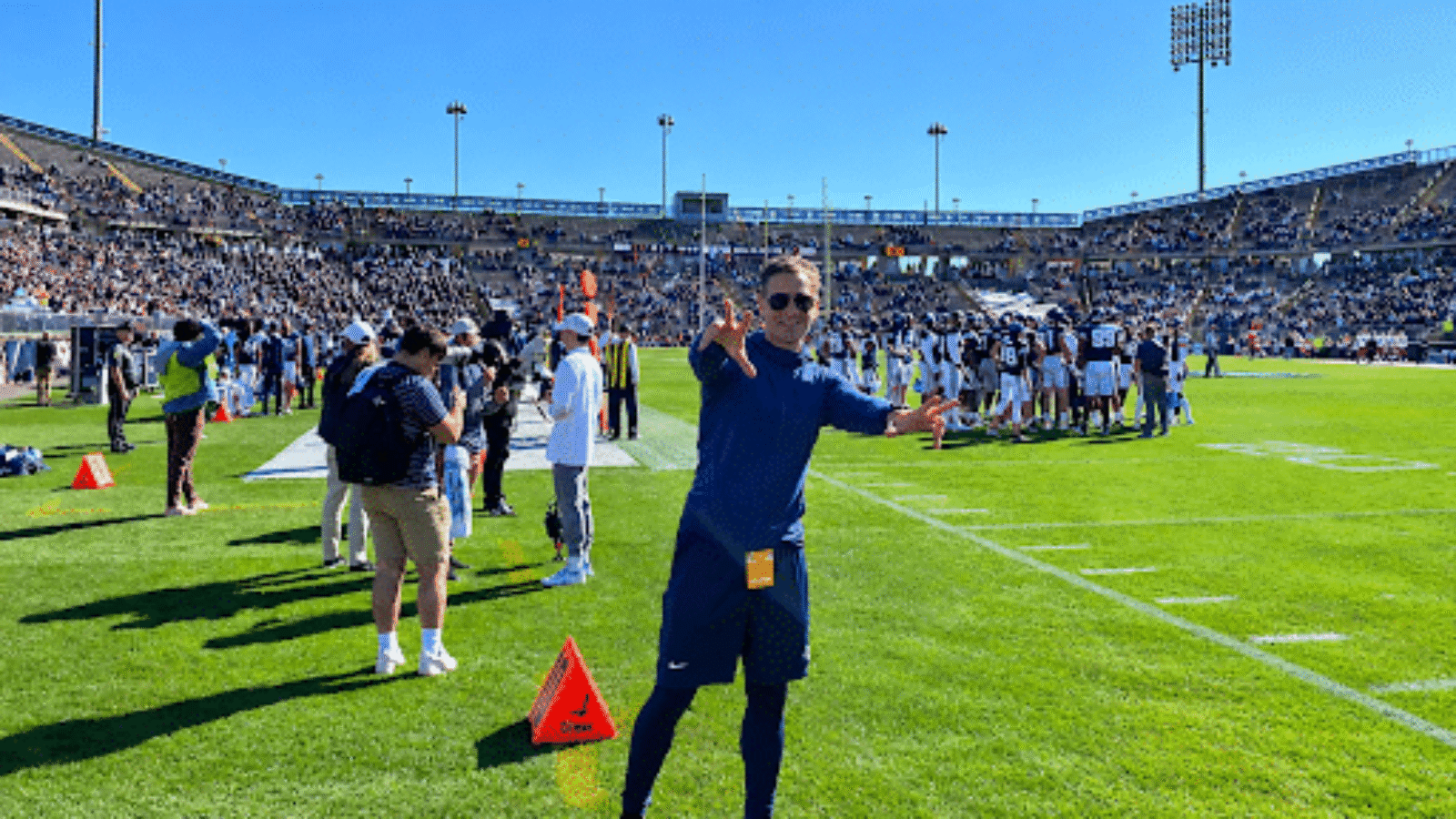
Leadership isn’t learned in a conference room alone.
Some of the most important lessons about leadership are learned when the pressure is on, when the outcome is uncertain, and when other people are counting on you to do your job.
I learned many of those lessons during my five years in the NFL.
Football taught me that leadership isn’t about having the loudest voice in the room. It’s about preparation, accountability, communication, resilience and the ability to bring people together around a common goal.
Those same principles apply far beyond professional sports.
Today, as a former NFL keynote speaker and athlete who has gone on to build businesses, lead teams, climb Mount Everest and complete the Seven Summits, I bring those experiences to organizations looking for practical lessons in leadership, teamwork and overcoming adversity.
Whether you’re leading a company, managing a team or navigating a major career transition, the lessons from the football field can translate directly to the boardroom.
Leadership Is About More Than Being in Charge
One of the biggest misconceptions about leadership is that having a title automatically makes someone a leader.
It doesn’t.
In football, every player has a role. The quarterback has one responsibility. The wide receiver has another. The offensive lineman has another. Coaches have different responsibilities again.
But successful teams understand something important:
Everyone is responsible for the outcome.
The best leaders create an environment where people understand their role, trust the people around them and understand how their individual contribution fits into the larger mission.
The same is true in business.
A CEO doesn’t win alone. Neither does a sales executive, department head or entrepreneur.
Great organizations succeed when everyone understands the mission and takes ownership of their part of it.
That is one of the most important leadership lessons I took from the NFL.
Lesson #1: Accountability Builds Trust
In professional football, there is nowhere to hide.
If you miss an assignment, someone knows.
If you aren’t prepared, it shows.
If you make a mistake on Sunday, you don’t get to spend the rest of the week pretending it didn’t happen.
You have to own it, learn from it and get ready for the next opportunity.
That’s accountability.
And accountability is one of the foundations of great leadership.
In business, accountability doesn’t mean creating a culture of blame. It means creating a culture where people are willing to say:
“That’s my responsibility. Here’s what happened. Here’s what I’m going to do about it.”
When leaders demonstrate that behavior themselves, they create trust.
People are much more willing to take responsibility when they know their leader will do the same.
Lesson #2: Preparation Creates Confidence
Football players don’t walk onto the field on Sunday and suddenly become prepared.
The preparation happens during the week.
Meetings. Film study. Practice. Conditioning. Repetition.
When game day arrives, you’re relying on the work you’ve already put in.
Leadership works the same way.
Confidence isn’t something you simply turn on when you’re standing in front of a team or making an important decision.
Confidence comes from preparation.
I’ve carried that lesson into every major challenge I’ve faced since football—including climbing Mount Everest.
Everest doesn’t care about your résumé.
It doesn’t care what you’ve accomplished in the past.
You have to prepare for the conditions in front of you.
That mindset applies to business leadership as well. The more prepared you are, the better equipped you are to make difficult decisions when circumstances change.
Lesson #3: Communication Can Make or Break a Team
A football team can have incredible individual talent and still fail if the players aren’t communicating.
Everyone has to know the assignment.
Everyone has to understand the plan.
And everyone has to adjust when the situation changes.
The boardroom isn’t much different.
Leaders need to communicate expectations clearly. They need to listen. They need to make sure people understand not only what needs to happen, but why it matters.
And perhaps most importantly, leaders need to communicate during difficult moments.
It’s easy to communicate when everything is going well.
The real test comes when the company misses a target, a major customer leaves, a project fails or an unexpected crisis appears.
That’s when people look to leadership.
Lesson #4: Reliability Is an Underrated Leadership Skill
Talent gets attention.
Reliability builds organizations.
In the NFL, coaches and teammates need to know that when your number is called, you’re going to do your job.
You don’t necessarily have to be the biggest star.
You have to be someone your teammates can count on.
That lesson has stayed with me throughout my career.
The same principle applies to business.
Can your employees count on you?
Can your customers count on you?
Can your partners count on you?
Can your team trust that you’ll follow through on what you said you would do?
Leadership is built one promise kept at a time.
Lesson #5: Adversity Reveals Leadership
Nobody has a perfect career.
Every leader eventually faces adversity.
The question isn’t whether something will go wrong.
The question is how you respond when it does.
My experiences in professional football, entrepreneurship and mountaineering have reinforced that lesson over and over again.
Adversity has a way of stripping away the unnecessary.
It forces you to determine what’s important, make decisions and keep moving.
That’s why some of the most valuable leadership lessons don’t come from victories.
They come from setbacks.
A team that loses together can learn how to come back stronger.
A company that experiences failure can discover what it needs to change.
A leader who experiences adversity can become more resilient and more empathetic.
The goal isn’t to avoid adversity.
The goal is to become better because of it.
Lesson #6: Great Teams Are Built on Trust
Football is the ultimate team sport.
You can’t win consistently with eleven people trying to do their own thing.
You need trust.
The offensive line has to trust the quarterback.
The quarterback has to trust his receivers.
Players have to trust the coaching staff.
And everyone has to trust that the person next to them will do their job.
Business leaders face the same challenge.
You can hire incredibly talented people, but if they don’t trust one another, performance will suffer.
Great leaders create cultures where people can speak honestly, challenge ideas, admit mistakes and still know that they’re part of the team.
Trust doesn’t mean everyone agrees.
It means everyone is committed to the same mission.
From the Locker Room to the Boardroom
When I speak to companies and organizations, I don’t talk about football simply for the sake of talking about football.
The football stories are the vehicle.
The real subject is leadership.
It’s about what happens when people face pressure.
It’s about building teams.
It’s about communication.
It’s about resilience.
It’s about accepting responsibility.
And it’s about finding the courage to pursue something bigger than yourself.
Those lessons became even more meaningful to me after my NFL career.
Building businesses taught me about entrepreneurship and risk.
Leading organizations taught me about people and culture.
And climbing the world’s highest mountains taught me about preparation, perseverance and the importance of taking one step at a time.
Those experiences have shaped the way I think about leadership today.
Why an Athlete Keynote Speaker Can Bring a Different Perspective
There is a reason organizations continue to bring athletes into corporate environments.
Athletes understand pressure.
They understand preparation.
They understand teamwork.
They understand winning and they understand losing.
But the most effective athlete keynote speaker doesn’t simply tell sports stories.
The speaker connects those experiences to the challenges the audience is facing today.
That’s what I strive to do.
My goal isn’t for an audience to leave a keynote thinking, “That was a great football story.”
I want them to leave thinking:
“How can I apply that lesson to my team, my company and my life?”
That’s where the real value of a keynote begins.
Finding Your Summit
My keynote message is built around a simple idea:
Everyone has a summit.
Your summit might be growing a company.
It might be becoming a better leader.
It might be rebuilding after a setback.
It might be taking your career in an entirely new direction.
Or it might be pursuing something you’ve always believed was impossible.
The path isn’t always easy.
There will be setbacks, unexpected obstacles and moments when you question whether you can keep going.
But the same principles that helped me navigate an NFL career and ultimately reach the summit of Mount Everest can help anyone pursue their own goals.
Prepare.
Build the right team.
Communicate.
Be accountable.
Stay resilient.
And keep moving forward.
Leadership Isn’t a Destination
The greatest leaders I’ve encountered understand that leadership isn’t something you finish learning.
There is always another challenge.
Another mountain.
Another team.
Another opportunity to get better.
That’s one of the reasons I call my keynote Finding Your Summit.
The summit isn’t just a destination.
It’s a mindset.
It’s the decision to challenge yourself, embrace adversity and continue moving toward something meaningful.
My journey took me from the NFL locker room to the business world and ultimately to the top of Mount Everest.
But the lessons I’ve learned along the way aren’t really about football or climbing.
They’re about people.
They’re about leadership.
And they’re about what we’re capable of accomplishing when we prepare, work together and refuse to give up.
If your organization is looking for an NFL motivational speaker, a former professional athlete or an experienced former NFL keynote speaker who can bring real-world lessons about leadership, resilience, teamwork and adversity to your audience, I’d love to connect.
Your next summit may be closer than you think.
Frequently Asked Questions
What does an NFL motivational speaker talk about?
An NFL motivational speaker typically draws on experiences from professional football to discuss leadership, teamwork, accountability, resilience, preparation, communication and overcoming adversity.
What can businesses learn from professional football?
Businesses can learn many of the same principles that make successful football teams effective, including accountability, communication, preparation, trust and clearly defined roles.
What makes a former NFL player a good keynote speaker?
Former NFL players have firsthand experience dealing with high-pressure environments, teamwork, competition, preparation and adversity. The best keynote speakers translate those experiences into practical lessons that business audiences can apply.
What is an athlete keynote speaker?
An athlete keynote speaker uses experiences from sports and competition to inspire audiences and provide lessons about leadership, teamwork, resilience, goal-setting and performance.
What topics does Mark Pattison speak about?
Mark Pattison speaks about leadership, resilience, teamwork, communication, accountability, overcoming adversity and finding your personal or professional summit. His experiences include playing in the NFL, building businesses and climbing Mount Everest and the Seven Summits.
How do I book Mark Pattison as a keynote speaker?
Organizations interested in having Mark Pattison speak at a corporate event, conference or leadership program can contact him through www.MarkPattisonNFL.com.
Author Bio