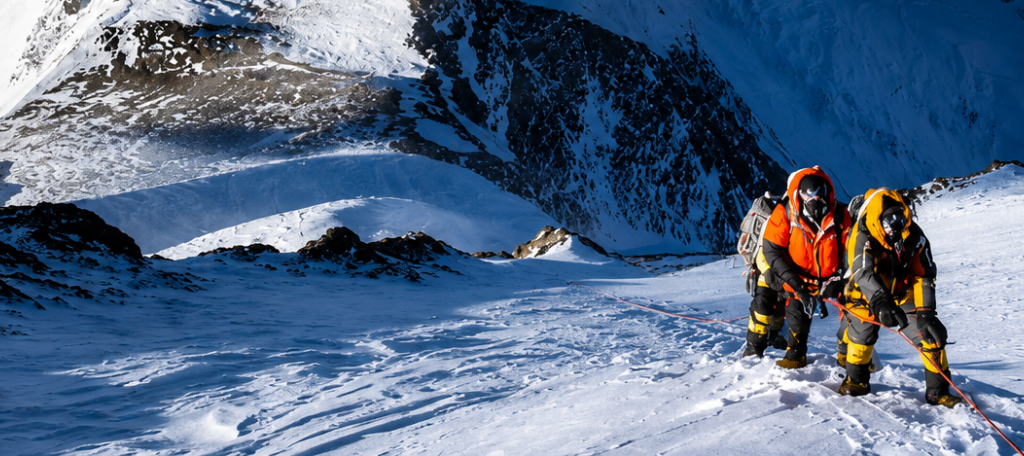
What Climbing Everest Teaches US about Leadership in Uncertain Times
In today’s rapidly changing business environment, leaders are constantly navigating uncertainty. Markets shift overnight, technology evolves at lightning speed, and unexpected challenges can test even the most experienced executives. While leadership books and business seminars offer valuable insights, some of the most profound lessons I’ve learned came not from a boardroom, but from standing on the ice on Mount Everest.
As the first former NFL player to climb the Seven Summits, including Mount Everest, I experienced firsthand what it means to lead, adapt, and make critical decisions in one of the most unforgiving environments on Earth. The mountain doesn’t care about your title, your bank account, or your past accomplishments. It only responds to preparation, teamwork, humility, and sound decision-making.
The lessons I learned on Everest have direct applications to leadership in business, especially during uncertain times.
Leadership Under Pressure: The Ultimate Test
Leadership is easy when conditions are favorable. It’s much harder when the stakes are high, resources are limited, and the outcome is uncertain.
On Everest, every decision carries consequences. Weather can change in minutes. Oxygen supplies are finite. Fatigue clouds judgment. A single mistake can become life-threatening.
Similarly, business leaders often face moments where there is no perfect information available. During economic downturns, organizational restructuring, industry disruption, or crisis situations, leaders must make decisions without knowing exactly how events will unfold.
True leadership isn’t about having all the answers. It’s about maintaining clarity when others feel overwhelmed.
Real Everest Leadership Challenges
Many people imagine climbing Everest as a physical challenge. In reality, it’s a leadership challenge disguised as a mountain.
During an Everest expedition, climbers face:
- Unpredictable weather conditions
- Physical exhaustion
- Team dynamics under stress
- Limited resources
- Constant risk assessment
- Communication challenges
- Difficult go-or-no-go decisions
At high altitude, emotions run high and energy runs low. Team members may become frustrated, fearful, or discouraged. Leaders must remain composed while helping others stay focused on the mission.
These challenges mirror what executives face during major business transitions. Whether leading a merger, navigating market disruption, or managing a company through uncertainty, the pressure can be immense.
The ability to remain calm, focused, and decisive becomes a leader’s greatest asset.
Decision-Making in High-Stakes Situations
One of the most important lessons Everest teaches is that waiting for perfect certainty can be dangerous.
Near the summit, climbers often face a critical decision: continue upward or turn around.
The summit may be within sight. Years of preparation have led to this moment. Yet experienced leaders understand that reaching the top is optional; returning safely is mandatory.
Many climbers have gotten into trouble because they allowed emotion, ego, or sunk costs to override sound judgment.
Business leaders face similar situations every day.
Perhaps you’ve invested millions into a project that isn’t performing. Maybe market conditions have changed. Maybe a strategy that once made sense no longer does.
Great leaders ask:
- What are the facts?
- What risks are emerging?
- What information am I missing?
- What is the long-term consequence of this decision?
The willingness to pivot, adjust, or even abandon a plan when circumstances change is often what separates successful leaders from struggling ones.
Managing Risk and Uncertainty
Contrary to popular belief, Everest climbers are not risk seekers.
The best climbers are actually exceptional risk managers.
Every successful summit attempt involves evaluating:
- Weather forecasts
- Route conditions
- Team health
- Equipment reliability
- Oxygen levels
- Emergency contingencies
The goal isn’t to eliminate risk. That’s impossible.
The goal is to identify, understand, and manage risk intelligently.
The same principle applies in business.
Leaders who thrive during uncertainty don’t ignore risk. They create systems for evaluating it. They develop contingency plans. They prepare for multiple outcomes.
Most importantly, they recognize that uncertainty is not a reason to stop moving forward.
Progress requires calculated action.
Team Communication and Trust
No one climbs Everest alone.
Even though only one person may stand on the summit at a given moment, reaching that point requires an entire team working together.
Trust becomes everything.
When conditions deteriorate, communication must be clear, direct, and honest. Team members need confidence that everyone is operating from the same information and pursuing the same objectives.
On Everest, poor communication can be fatal.
In business, poor communication can destroy culture, derail projects, and erode trust.
The strongest leaders create environments where:
- Team members feel heard
- Information flows openly
- Expectations are clear
- Accountability is shared
- Feedback is welcomed
Trust is built long before a crisis occurs. When challenges arise, teams draw upon the trust they’ve established through consistent leadership and communication.
Seven Leadership Lessons from Everest
1. Clarity Creates Confidence
When uncertainty increases, people look to leaders for direction.
Leaders don’t need all the answers, but they must provide clarity about priorities, goals, and next steps.
2. Preparation Beats Talent
Success on Everest is determined long before summit day.
In business, preparation, planning, and disciplined execution consistently outperform raw talent alone.
3. Adaptability Is a Competitive Advantage
Conditions change.
Leaders who cling rigidly to outdated plans often struggle. Those who adapt while staying committed to their mission thrive.
4. Ego Is the Enemy
Many Everest tragedies occur because climbers refuse to turn back.
The best leaders separate ego from decision-making and focus on what serves the team and organization.
5. Trust Is Built Before You Need It
You cannot create trust in the middle of a crisis.
Strong teams invest in relationships, transparency, and accountability every day.
6. Small Steps Lead to Big Outcomes
The summit is reached one step at a time.
Business transformation works the same way. Consistent progress compounds over time.
7. Resilience Is More Important Than Perfection
No expedition goes exactly as planned.
The ability to recover from setbacks, learn from mistakes, and continue moving forward is one of leadership’s most valuable traits.
Actionable Takeaways for Business Leaders
If you’re leading through uncertain times, consider implementing these practices:
- Conduct Regular Risk Assessments
Don’t wait for problems to emerge. Identify potential challenges before they become crises.
- Improve Communication Cadence
Increase transparency with your team. Frequent communication reduces uncertainty and builds confidence.
- Create Decision Frameworks
Establish criteria for evaluating opportunities, risks, and strategic pivots before emotions enter the equation.
- Invest in Team Trust
Strong relationships improve performance under pressure. Make trust-building a leadership priority.
- Focus on What You Can Control
You cannot control markets, competitors, or external events. You can control preparation, mindset, communication, and execution.
- Stay Mission-Focused
The route may change, but the objective remains the same. Great leaders adjust tactics while remaining committed to their vision.
Final Thoughts
Mount Everest taught me that leadership is not about authority—it’s about responsibility. It’s about helping others move forward when the path isn’t clear. It’s about making difficult decisions with incomplete information. It’s about remaining calm when conditions become chaotic.
The mountain doesn’t reward the strongest climber. It rewards the most prepared, adaptable, and resilient.
The same is true in business.
Whether you’re leading a company, a team, or your own personal journey, uncertainty is inevitable. The leaders who succeed are those who embrace the challenge, trust their preparation, communicate clearly, and keep moving forward one step at a time.
Because in leadership, just like on Everest, the summit is never guaranteed—but growth always is.
FAQ
Everest requires decision-making under pressure, risk management, teamwork, communication, adaptability, and resilience—the same qualities required to lead organizations successfully during uncertain times.
The importance of making sound decisions despite uncertainty. Leaders rarely have perfect information, but they must still act with confidence and clarity.
Resilience comes from preparation, maintaining perspective, focusing on controllable factors, and learning from setbacks rather than being defined by them.
Trust enables teams to communicate openly, collaborate effectively, and perform under pressure. Without trust, even the best strategy can fail.
Effective leaders understand that risk cannot be eliminated. Instead, they identify risks early, create contingency plans, and make informed decisions that balance opportunity with potential consequences.
Author Bio

Mark Pattison is a former NFL player, entrepreneur, author, and internationally recognized keynote speaker. As the first former NFL player to complete the Seven Summits, he inspires audiences worldwide with powerful insights on leadership, resilience, peak performance, and overcoming adversity.
Read Full Bio ➜