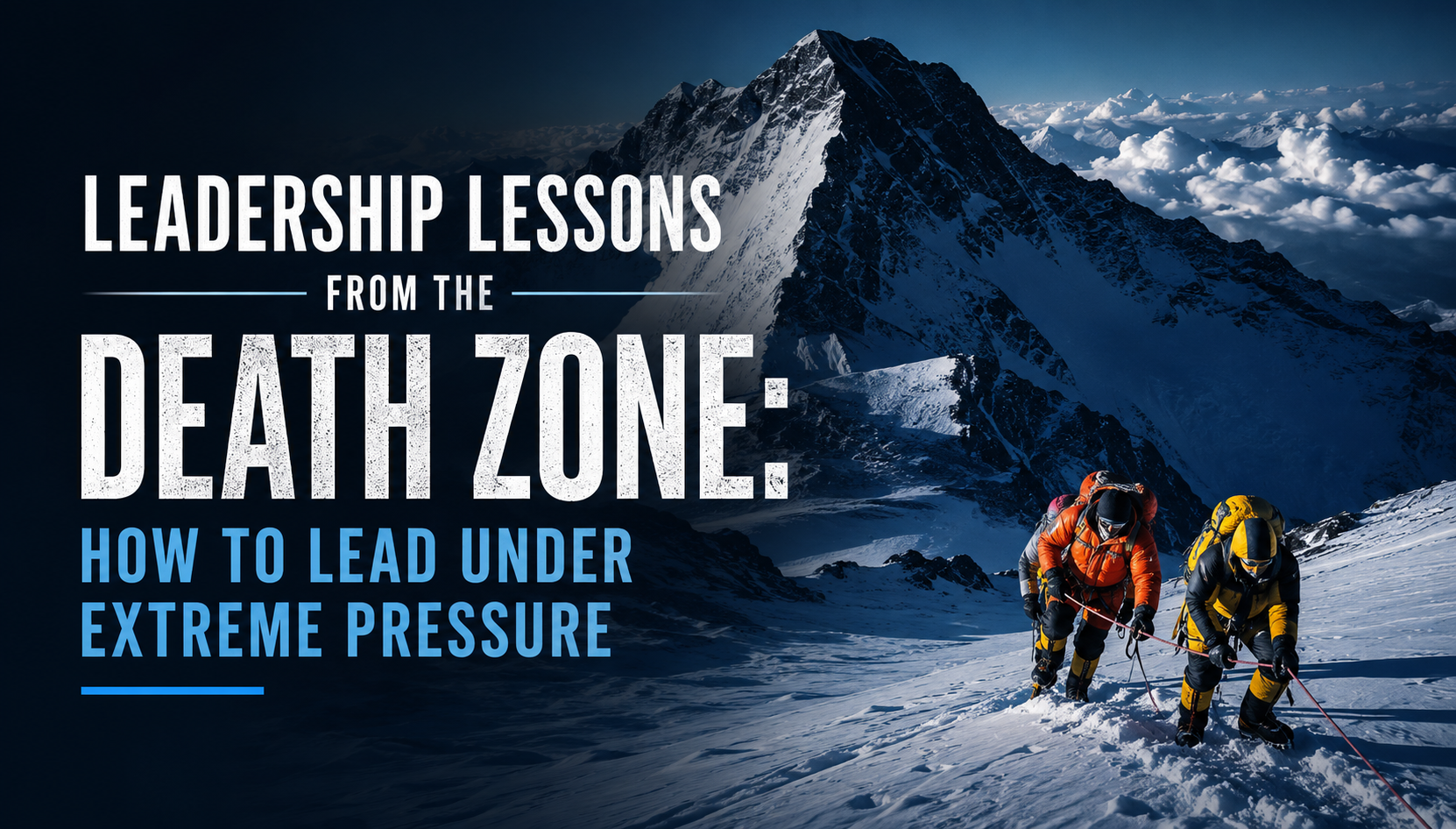
Leadership Lessons from the Death Zone: How to Lead Under Extreme Pressure
What does climbing Mount Everest have to do with leadership?
More than you might think.
Above 26,000 feet on Mount Everest lies an area known as the Death Zone. At this altitude, the human body can no longer properly acclimatize. The air contains roughly one-third of the oxygen available at sea level. Your body is deteriorating, your thinking can become clouded, and every decision carries greater consequences.
I experienced this environment firsthand while climbing Mount Everest and completing my journey to become an NFL player who went on to climb the Seven Summits.
Standing high on the world’s tallest mountain taught me lessons about leadership under extreme pressure that no boardroom, business book, or leadership seminar ever could.
Because when the stakes are high, leadership is no longer theoretical.
It becomes very real.
Throughout my career—from playing five seasons in the NFL to building businesses, serving as a senior executive in the sports media industry, and eventually standing on top of Mount Everest—I have learned that pressure reveals who we are.
The Death Zone reinforced one of the most important lessons of my life:
Great leadership isn’t about having all the answers. It’s about knowing how to move forward when you don’t.
Every leader eventually enters a version of the Death Zone.
It might be a business crisis. A major setback. A struggling team. A failed strategy. A career transition. Or a moment when everything seems to be happening at once and everyone is looking to you for direction.
The environment changes.
The principles of great leadership do not.
1. Under Pressure, Your Priorities Must Become Clearer
On Mount Everest, there are countless things you could worry about.
The weather. The cold. Your equipment. Your oxygen supply. The climbers around you. The distance remaining to the summit.
Trying to process everything at once can quickly become overwhelming.
The key is identifying what matters most right now.
The same principle applies to leadership under pressure.
When organizations face uncertainty, leaders often respond by adding complexity—more meetings, more initiatives, more communication, and more priorities.
Extreme environments demand the opposite.
They demand clarity.
A strong leader continually asks:
What matters most right now?
When the pressure rises, your team doesn’t need 20 priorities. They need to understand the most important objective, what role they play, and why it matters.
Clarity creates confidence.
Confusion creates hesitation.
One of the most important responsibilities of leadership is cutting through the noise and giving people a clear path forward.
2. Focus on What You Can Control
You cannot control the weather on Mount Everest.
You cannot control the mountain.
You cannot control every decision another climber makes.
But you can control your preparation, attitude, effort, equipment, and response when circumstances change.
This lesson has followed me throughout my life.
High performers understand the difference between what concerns them and what they can actually control.
When leaders spend too much time worrying about circumstances outside their influence, they waste valuable energy that could be directed toward action.
When facing pressure, ask two questions:
What can’t we control?
Then ask the more important question:
What can we do next?
The second question moves you from fear to action.
And that is where effective leadership begins.
3. The Summit Is Optional. Getting Down Is Mandatory.
There is a powerful principle in mountaineering:
The summit is optional. Getting down is mandatory.
This may be one of the most important leadership lessons I learned from climbing Mount Everest.
Ambition is essential.
Goals matter.
Winning matters.
But ambition without judgment can become dangerous.
On a mountain, climbers can become so obsessed with reaching the summit that they ignore changing weather, exhaustion, declining oxygen levels, or established turnaround times.
This is often called summit fever.
Business leaders can experience their own version of summit fever.
We become emotionally attached to a strategy because we created it.
We continue investing in an initiative because we have already spent so much money on it.
We refuse to change direction because changing direction might look like failure.
Great leaders understand that changing the plan is not the same as abandoning the mission.
Sometimes leadership means pushing forward.
Sometimes it means waiting.
And sometimes the strongest leadership decision you can make is to turn around.
The goal is not to prove your original plan was right.
The goal is to accomplish the mission while protecting the people who are depending on you.
4. Preparation Determines How You Perform Under Pressure
Nobody prepares to climb Mount Everest in a week.
My journey to the top of the world was built over years of training, climbing, setbacks, failures, lessons, and preparation.
Leadership works the same way.
When a crisis arrives, you rarely have time to suddenly develop discipline, trust, communication, resilience, or mental toughness.
Those qualities must already exist.
Pressure reveals preparation.
If you build strong relationships before a crisis, your team is more likely to trust you during one.
If you establish clear values before difficult decisions arise, those values become your compass.
If you practice making disciplined decisions, you are less likely to panic when the stakes increase.
The best time to prepare yourself and your organization for extreme pressure is before extreme pressure arrives.
5. Great Leaders Don’t Climb Alone
No one truly climbs Mount Everest alone.
Behind every successful summit is a network of Sherpas, guides, teammates, family members, coaches, and supporters.
The same is true in leadership.
One of the biggest myths surrounding successful people is that extraordinary accomplishments are achieved alone.
They aren’t.
Great leaders build great teams.
More importantly, they learn to trust those teams.
Under extreme pressure, micromanagement becomes a liability. No leader can be everywhere or make every decision.
You need capable people who understand the mission and are empowered to act.
Trust is not built during the crisis. It is tested during the crisis.
The strongest teams have already established communication, accountability, and mutual respect before the pressure reaches its highest point.
When the storm arrives, those relationships become your lifeline.
6. Slow Down When Everything Tells You to Speed Up
Pressure creates urgency.
Urgency can create panic.
And panic creates bad decisions.
One of the most counterintuitive lessons from extreme environments is that the faster everything is moving around you, the more deliberate your thinking may need to become.
That doesn’t mean being passive or indecisive.
It means refusing to let fear and emotion make important decisions for you.
Effective leaders create enough mental space to ask:
What do we know?
What don’t we know?
What has changed?
What are our options?
What happens if we’re wrong?
That brief moment of disciplined thinking can be the difference between reacting emotionally and responding strategically.
Calm is contagious.
When a leader remains composed, the team is more likely to remain composed.
When the leader panics, that spreads too.
Your emotional response becomes part of the environment your team must operate within.
7. Break the Impossible Goal Into the Next Step
Standing at the base of Mount Everest and looking toward the summit can feel overwhelming.
So can leading a company through a crisis, transforming an organization, or pursuing an enormous goal.
The mistake is trying to mentally climb the entire mountain at once.
You don’t.
You focus on the next step.
Then the next.
Then the next.
This idea is at the heart of my philosophy of Finding Your Summit.
Your summit might be building a company, transforming a team, changing careers, overcoming adversity, or accomplishing something others believe is impossible.
Whatever your summit is, you don’t reach it with one giant leap.
You reach it through thousands of small, disciplined decisions.
Progress creates momentum.
Momentum builds confidence.
And confidence helps people continue moving forward when the ultimate destination still feels far away.
8. Leadership Is Most Visible When Things Go Wrong
Anyone can lead when the weather is perfect.
Leadership is revealed when the storm arrives.
When things go wrong, people watch their leaders closely.
They watch your body language.
They listen to your words.
They notice whether you blame others or take responsibility.
They see whether you disappear or step forward.
Your team may forget many of the things you say during the easy times.
They will remember how you showed up during the difficult ones.
One of the most powerful questions any leader can ask during adversity is:
Who does my team need me to be right now?
Not tomorrow.
Not when the crisis is over.
Right now.
How Great Leaders Perform Under Extreme Pressure
The Death Zone on Mount Everest is one of the harshest environments on Earth.
But the leadership lessons I learned there apply far beyond the mountain.
Great leaders:
- Stay focused on what matters most.
- Control what they can control.
- Prepare before the pressure arrives.
- Trust the people around them.
- Know when to push forward and when to change course.
- Remain calm when everyone else is reacting.
- Break overwhelming challenges into manageable steps.
- Step forward when circumstances become difficult.
Leadership isn’t defined by how you perform when conditions are perfect.
It’s defined by how you respond when the oxygen is thin, the storm is closing in, the pressure is mounting, and the path forward is uncertain.
That’s when people need leadership the most.
And that’s when you discover what kind of leader you really are.
The question isn’t whether you will eventually face your own version of the Death Zone.
At some point, every leader will.
The question is: Will you be prepared to lead when you get there?
Find Your Next Summit
Mark Pattison is a former NFL player, successful business executive, entrepreneur, Emmy Award-winning executive producer, and one of the few people in the world to have completed the Seven Summits by climbing the highest mountain on every continent.
Through his Finding Your Summit platform, Mark shares lessons from professional sports, business, entrepreneurship, and Mount Everest to help leaders and organizations build resilience, overcome adversity, and achieve meaningful goals.
If your organization is looking for a keynote speaker who can inspire leaders to perform under pressure, overcome adversity, and reach their next summit, learn more about Mark Pattison’s keynote speaking programs.
For leaders navigating change, transition, or their next major challenge, explore executive leadership coaching with Mark Pattison.
If you want to know about Why Mental Toughness Matters More Than Talent in Long-Term Success Read our blog
Author Bio

Mark Pattison is a former NFL player, entrepreneur, author, and internationally recognized keynote speaker. As the first former NFL player to complete the Seven Summits, he inspires audiences worldwide with powerful insights on leadership, resilience, peak performance, and overcoming adversity.
Read Full Bio ➜