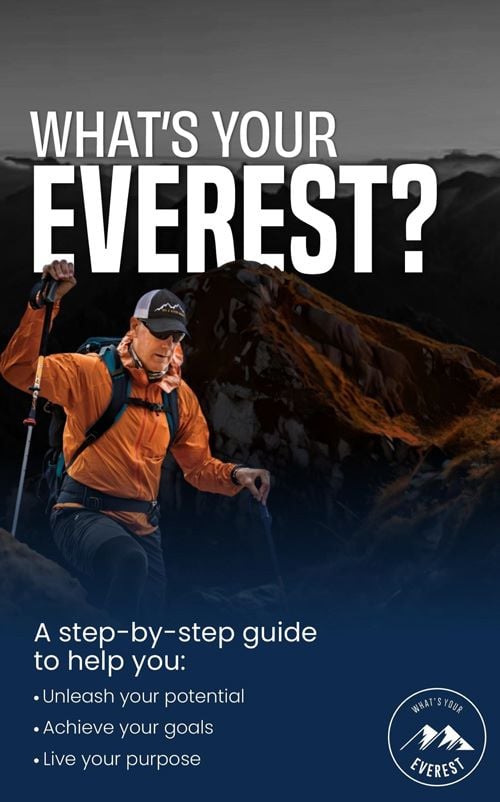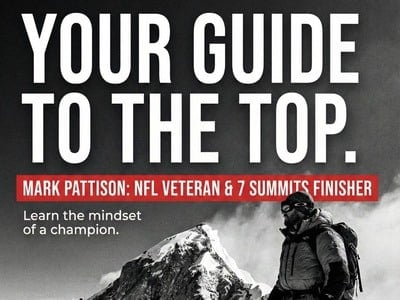
What can climbing Mount Everest teach a CEO about leadership, decision-making, resilience, and building high-performing teams?
Mark Pattison, former NFL wide receiver, business executive, entrepreneur, Seven Summits mountaineer, and Emmy Award winner, is developing a distinctive leadership experience that brings the lessons of extreme mountaineering into the world of executive leadership.
The Seven Summits Summit is designed to connect the challenges of climbing the world’s highest mountains with the real-world demands facing CEOs, founders, business owners, and C-suite executives.
Drawing on his experience in the NFL, his leadership career at Sports Illustrated, and his successful completion of the Seven Summits challenge, Pattison brings a unique perspective to the relationship between ambition, preparation, accountability, and performance.
The concept is built around a powerful question:
What would change in your leadership if you approached your business with the same preparation, discipline, and commitment required to climb Mount Everest?
For executives navigating organizational change, competitive pressure, business growth, and increasingly complex decisions, the answer may offer a new perspective on what it takes to reach the next summit.
What Is the Seven Summits Summit?
The Seven Summits Summit is an immersive leadership experience concept developed around the lessons of high-altitude mountaineering and their application to executive performance.
The experience is intended to help senior leaders examine how they set ambitious goals, prepare for uncertainty, make decisions under pressure, communicate with their teams, and maintain accountability when the stakes are high.
Rather than treating leadership as a collection of abstract theories, the experience draws on the practical demands of pursuing extraordinary objectives in environments where preparation, teamwork, and judgment matter.
Potential themes include:
- Executive leadership: Establishing a clear vision and aligning people around ambitious objectives.
- Decision-making under pressure: Evaluating risks, adapting to changing circumstances, and making difficult choices.
- Resilience and adaptability: Responding constructively when plans change or obstacles emerge.
- Team performance: Building trust, communication, and accountability across an organization.
- Preparation and execution: Turning strategic ambition into disciplined, measurable action.
- Personal reinvention: Challenging assumptions about what is possible at different stages of a career.
The central idea is straightforward: Reaching an ambitious goal requires more than talent and determination. It requires a system for preparing, making decisions, managing risks, and executing when conditions become difficult.
For C-suite executives, these lessons have direct relevance to leading organizations through uncertainty and pursuing sustainable growth.
Why Mountaineering Is a Powerful Model for Executive Leadership
In business, leaders frequently face situations in which the desired outcome is clear but the path forward is uncertain.
Markets shift. Competitors introduce new strategies. Teams encounter unexpected obstacles. Decisions must be made before all the information is available.
Mountaineering presents similar challenges in a very different environment.
Climbing a major mountain requires a clear objective, extensive preparation, appropriate resources, reliable teammates, and the ability to respond when conditions change. A successful team must recognize its limitations, evaluate risks, and understand when to continue, adjust its plan, or turn back.
These principles translate into several important leadership lessons.
1. Vision Must Be Supported by Preparation
Ambitious goals can inspire an organization, but a vision alone does not produce results.
Executives must translate strategic objectives into realistic plans, establish priorities, allocate resources, and prepare their teams for obstacles.
On a mountain expedition, preparation begins long before summit day. In business, high performance similarly depends on the work completed before the critical moment arrives.
2. The Best Leaders Adapt When Conditions Change
A carefully constructed plan may need to change when circumstances evolve.
Successful leaders recognize when new information requires a different approach. They remain committed to the objective without becoming so attached to their original strategy that they ignore changing conditions.
This ability to balance conviction with adaptability is essential when leading through uncertainty.
3. Teamwork Matters More Than Individual Ambition
Major mountaineering objectives depend on coordinated effort.
Team members must communicate, understand their responsibilities, trust one another, and recognize that individual decisions can affect the entire group.
Executive leadership presents the same challenge. An organization may have talented individuals, but performance suffers when departments operate in isolation or accountability is unclear.
Building a high-performing team requires shared objectives, effective communication, and a culture in which people take responsibility for their contributions.
4. Risk Management Is Part of Performance
Reaching a summit is not simply a test of determination.
It also requires judgment about weather, resources, timing, physical condition, and the consequences of continuing under unfavorable circumstances.
Business leaders likewise need to distinguish between calculated risk and unnecessary exposure.
The ability to recognize changing conditions, evaluate alternatives, and make difficult decisions is often as important as the ambition to pursue a goal.
5. Accountability Turns Strategy Into Results
A strategic plan creates value only when people execute it.
Leaders must establish clear expectations, monitor progress, address problems, and take responsibility for outcomes.
Whether an organization is launching a new initiative, expanding into a market, or navigating a difficult period, consistent execution remains essential.
The Seven Summits leadership concept uses the mountain as a framework for examining these behaviors in a memorable and practical way.
Meet Mark Pattison: From the NFL to Mount Everest
Mark Pattison’s background combines professional athletics, business leadership, entrepreneurship, and high-altitude mountaineering.
He played five seasons in the National Football League as a wide receiver for the Los Angeles Raiders and New Orleans Saints.
Following his NFL career, Pattison built a business career that included serving as a senior executive at Sports Illustrated. He helped develop the publication’s team-site network, applying the principles of strategy, leadership, and execution in a competitive digital media environment.
Pattison also founded Front Porch Classics, a venture-backed company that was acquired by University Games.
Later, he pursued one of mountaineering’s most recognized challenges: climbing the Seven Summits, the highest mountains on each of the seven continents.
His journey culminated in reaching the summit of Mount Everest on May 23, 2021.
The expedition and his personal journey were featured in the NFL Films documentary Searching for the Summit, which won a Best Picture Emmy Award.
These experiences inform Pattison’s approach to leadership, resilience, preparation, and performance. They also provide a distinctive foundation for conversations with executives about pursuing ambitious goals while navigating uncertainty and change.
Who Is the Seven Summits Summit Designed For?
The Seven Summits Summit is being developed with senior business leaders and organizations seeking a fresh perspective on leadership and performance in mind.
Potential audiences include:
CEOs and business owners: Leaders responsible for setting organizational direction, making consequential decisions, and guiding teams through change.
C-suite executives: Senior leaders responsible for strategy, operations, finance, revenue, technology, and organizational performance.
Executive leadership teams: Groups looking to improve alignment, strengthen trust, clarify accountability, and work more effectively toward shared objectives.
Entrepreneurs and founders: Business builders navigating growth, uncertainty, competition, and the challenges of scaling an organization.
Corporate retreat organizers: Companies seeking an engaging leadership experience that moves beyond traditional presentations and encourages reflection on real business challenges.
Leadership development programs: Organizations investing in the next generation of executives and seeking practical frameworks for resilience, decision-making, and team performance.
The intended audience is made up of leaders who want to challenge their assumptions, examine their approach to difficult decisions, and identify new ways to help their organizations perform.
From Inspiration to Application: Bringing Mountain Lessons Into the Boardroom
An effective leadership experience should do more than inspire attendees during an event. It should give them ideas they can carry into their organizations.
The Seven Summits Summit concept connects mountaineering stories with questions that matter in the executive environment:
- Is our organization pursuing the right summit?
- Have we adequately prepared for the challenges ahead?
- Are our people aligned around a shared objective?
- Do we recognize risks early enough to respond effectively?
- Can we adapt our strategy without losing sight of our goals?
- Are we holding ourselves and our teams accountable for execution?
- What assumptions are preventing us from reaching our potential?
These questions can help leadership teams examine their priorities and consider how they respond to pressure, uncertainty, and ambitious objectives.
Depending on the final event format, the experience could incorporate keynote storytelling, guided executive discussions, leadership exercises, and structured reflection.
The specific agenda, location, dates, and participation options will be announced as event details are finalized.
Why Executive Leadership Needs a New Perspective
Today’s executives operate in an environment where change is constant and the consequences of poor decisions can be significant.
Technical expertise and industry knowledge remain important, but leaders must also develop the judgment, resilience, and interpersonal skills needed to guide people through uncertainty.
The mountain offers a useful perspective because it strips complex challenges down to a set of fundamental questions:
What are we trying to accomplish?
What will it take to get there?
What risks must we understand?
Who is on the team?
How will we respond when the plan changes?
And how will we know when it is time to push forward, adjust our approach, or reconsider the objective?
For Pattison, these questions connect the lessons of his mountaineering journey with the responsibilities of executive leadership.
The objective is not to suggest that business and mountaineering are identical. Rather, it is to use the demands of a challenging expedition to examine the principles that help leaders prepare, adapt, communicate, and execute.
About Mark Pattison
Mark Pattison is a former NFL wide receiver, entrepreneur, business executive, Seven Summits mountaineer, keynote speaker, and Emmy Award winner.
His professional background spans the NFL, Sports Illustrated, entrepreneurship, and high-altitude mountaineering. In 2021, he reached the summit of Mount Everest, completing his pursuit of the Seven Summits.
His Everest journey was featured in the NFL Films documentary Searching for the Summit, which won a Best Picture Emmy Award.
Through his speaking and leadership work, Pattison shares lessons about resilience, leadership, peak performance, accountability, and pursuing ambitious goals.
Learn more about Mark’s work, speaking topics, and leadership philosophy at MarkPattisonNFL.com.
Explore the Seven Summits Summit
The Seven Summits Summit is being developed as a distinctive leadership experience connecting the lessons of mountaineering with the challenges of executive performance.
For CEOs, founders, C-suite executives, and organizations interested in leadership development, the concept offers a compelling way to examine preparation, risk, teamwork, adaptability, and execution through the lens of an extraordinary personal journey.
Interested in the Seven Summits Summit or a leadership experience with Mark Pattison?
Visit MarkPattisonNFL.com to explore speaking opportunities and inquire about future event announcements.
The next summit starts with a decision: to challenge the way you think, lead, and perform.